
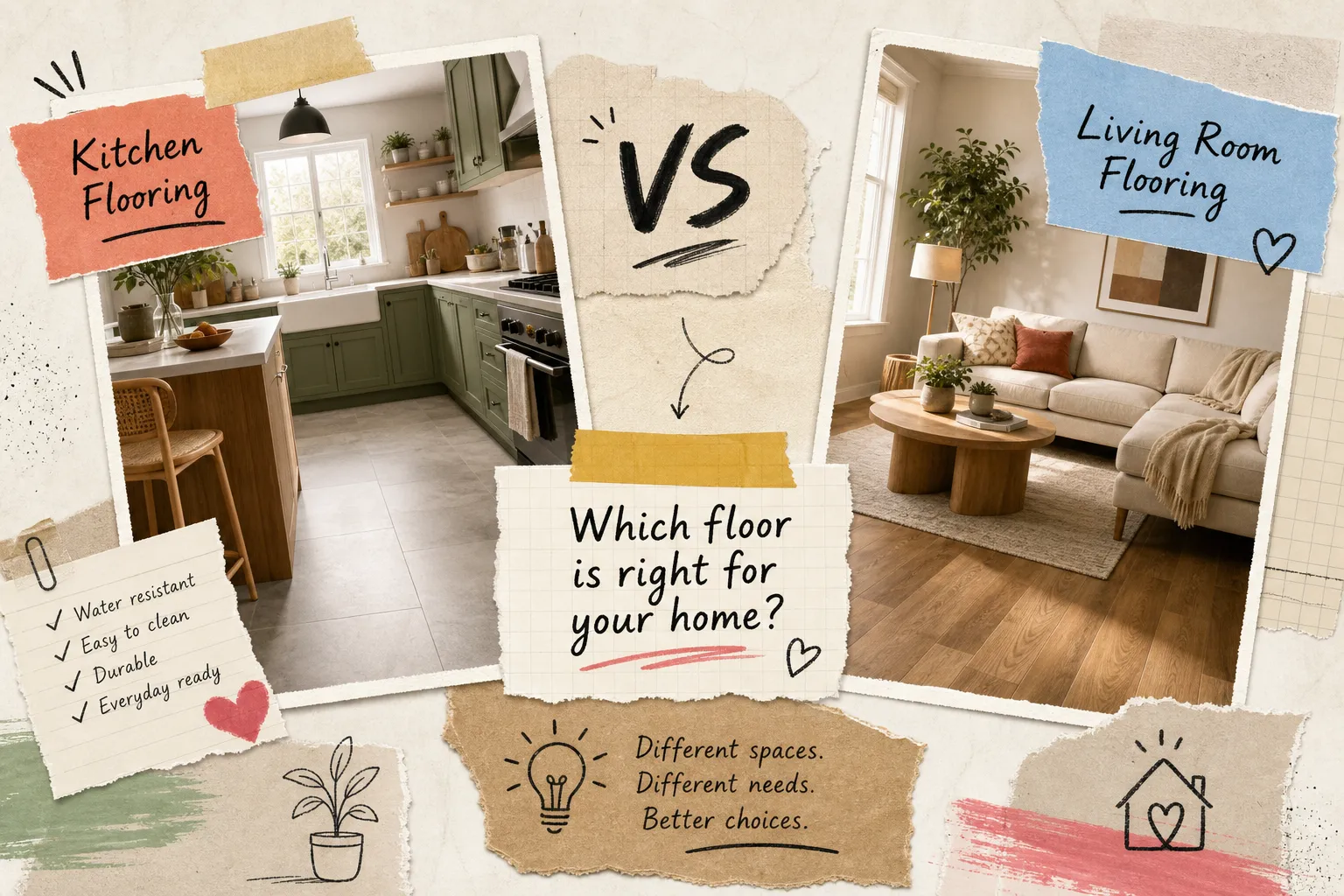
Room-by-Room Flooring Guide · Floors and Beyond
If you're trying to figure out what flooring to put in your kitchen versus your living room, whether one material should run through both spaces or each room needs something different, you're asking exactly the right question. It's a fair one, and the confusion is completely understandable. These two rooms share a wall on your floor plan but operate in entirely different ways day to day. One is a work zone. The other is a refuge. Treating them the same without thinking it through leads to real problems down the road.
We often hear this question from homeowners across Northern Virginia before we ever pull out a sample. The right answer always depends on how your household uses the space, what each room has to survive, and how much you're willing to spend. This guide walks through all of it.
A note from the Floors and Beyond crew
We answer this exact question in Northern Virginia homes every week. Our experienced in-house crew brings samples to your kitchen and living room, measures both, and gives you a straight answer — free, with no obligation.
Request a Free In-Home Estimate Call (703) 906-5698Why your kitchen and living room demand very different floors
These two rooms look like neighbors on a floor plan but function in completely opposite ways. A kitchen is a work environment that takes daily punishment. A living room is a comfort environment built for relaxation and first impressions. Choosing a single material without accounting for that difference leads to either an underperforming kitchen floor or an unnecessarily expensive, overbuilt living room floor.
What your kitchen floor actually has to survive
Think about what a kitchen floor endures on an average Tuesday: someone standing at the stove for 45 minutes, water pooling near the sink or dishwasher, a dropped glass, grease spatter, and constant foot traffic from morning coffee through after-dinner cleanup. Moisture resistance isn't a nice-to-have in a kitchen, it's the first filter any flooring material needs to pass.
Subfloor conditions matter here too. Many homes in Northern Virginia sit on concrete slabs, and moisture vapor rising from below is a real factor that affects which materials can be safely installed and how they need to be prepared.
What your living room floor actually needs to deliver
The living room is a different conversation entirely. The demands shift toward comfort, acoustics, and aesthetics. Furniture weight, softer traffic patterns, and the warmth a floor adds to a room all carry more weight here than spill resistance.
Resale value plays a role too: buyers in markets like Fairfax, Loudoun, and Arlington form a judgment about a home's character within moments of entering the living room. Hardwood in a living room signals quality and craftsmanship in a way that's harder to replicate in a kitchen, where that same floor would spend its life fighting moisture it wasn't built to handle.
What flooring should I put in my kitchen versus living room? Key factors to consider
Kitchen flooring decisions should start with moisture tolerance and work backward from there. A few materials consistently earn the top spots, each for different reasons.
Porcelain tile: the most durable choice for high-moisture kitchens
Porcelain tile leads the durability ranking for a reason: it has very low water absorption, a scratch-resistant surface, and a lifespan that can last decades under normal residential use, outlasting most other flooring materials. In Northern Virginia, installed costs typically run $12 to $25 per square foot for standard residential work, with complex patterns or larger-format tiles pushing that number higher.
The honest trade-offs are worth naming upfront. Porcelain is harder on joints during long cooking sessions, grout lines need periodic cleaning to stay looking sharp, and a dropped ceramic bowl isn't surviving contact with it. Porcelain is the right call for homeowners who prioritize function and longevity above everything else.
LVP: the practical, waterproof middle ground
For most households, luxury vinyl plank is the most balanced kitchen flooring choice available right now. It's fully waterproof or highly water-resistant, softer underfoot than tile, and installs at roughly $4 to $10 per square foot (regional 2026 estimates; costs vary by product and scope).
Quality varies significantly by wear layer thickness, and that detail matters in a kitchen. Look for a wear layer of 20 mil or above for active households, 20 to 22 mil is the practical residential sweet spot for kitchens with heavy foot traffic or pets. LVP won't be refinished over decades the way hardwood can, but it requires almost no ongoing maintenance beyond regular sweeping and an occasional damp mop.
Engineered hardwood: wood warmth with a moisture caveat
Many homeowners want the look and feel of real wood in a kitchen, and engineered hardwood makes that realistic in the right conditions. Its layered construction makes it dimensionally more stable than solid hardwood in humidity-heavy environments, and installed costs typically fall between $8 and $16 per square foot.
The key limitation is that it isn't waterproof. Spills need prompt cleanup, and long-term exposure to moisture from below a concrete slab can still cause cupping or swelling. Engineered hardwood works best in low-moisture kitchens or open-concept layouts where maintaining visual continuity with an adjacent living room or dining area is the priority.
The best flooring options for your living room
Living room flooring decisions are led by comfort, aesthetics, and resale appeal rather than water resistance. Some materials that would be a poor fit in a kitchen become the obvious right choice here.
Hardwood: the long-term investment with the highest resale return
For living rooms in Northern Virginia's mid-to-upper tier market, hardwood is still the gold standard. It can be refinished multiple times over its lifetime, lasts generations with proper care, and consistently delivers one of the strongest resale returns of any flooring upgrade. In the DC metro area, real hardwood on the main level is what buyers expect in homes priced above $600,000, particularly in neighborhoods like McLean, Vienna, and Alexandria.
Beyond resale, hardwood brings acoustic warmth and a grounded, quality feel to a living room that LVP or tile genuinely can't replicate. It works best where moisture exposure is low and the home's HVAC keeps temperature and humidity stable.
LVP: the smart pick for households that live hard
Not every household is the right fit for hardwood's maintenance demands, and that's where LVP earns its place in living rooms too. It delivers a convincing wood look with real scratch resistance, full waterproofing for homes with pets or young kids, and a lower installed cost that makes it the dominant choice for busy family homes and investment properties across the region. If long-term refinishability matters less than day-to-day durability and easy upkeep, LVP is a rational, well-performing choice that photographs well and shows well at resale.
Carpet: when comfort and acoustics take priority
Carpet earns a place in this conversation, especially for den areas, media rooms, or living spaces used primarily for relaxing. It installs at $4 to $9 per square foot in Northern Virginia, making it the most budget-friendly option on the list. The sound absorption and underfoot softness carpet provides are real advantages in rooms where young children play on the floor or where noise management matters.
The honest maintenance trade-off is equally real: carpet stains, traps allergens, and wears faster in high-traffic zones. It works best in living rooms that see moderate traffic rather than serving as the main path through a home.
Should you match your kitchen and living room floors?
This is one of the most debated decisions in residential flooring. The answer depends almost entirely on your home's layout, and whether there's an architectural break between those two spaces.
Open-concept layouts: the case for continuous flooring
When your kitchen flows directly into a living or dining area without a door or defined architectural break, running the same material through both spaces almost always looks cleaner and more intentional. It makes rooms feel larger, removes the visual awkwardness of "where does one floor end and the other begin," and simplifies the installation.
The material needs to perform in both environments, which points toward LVP or engineered hardwood as the most practical candidates. Both handle typical kitchen conditions while delivering the warm aesthetic a living area needs.
Matching floors: what flooring should I put in my kitchen versus living room in open-concept homes?
When there's a defined doorway or architectural break between rooms, mixing materials is completely workable and can highlight each room's distinct character. The transition detail is where many projects go wrong. For floors at the same height, a T-molding profile keeps the connection clean. When one floor sits higher than the other, a reducer strip handles the elevation change and eliminates a tripping hazard. The transition piece should be thin, color-matched, and placed at an architectural break or doorway where it reads as intentional and avoids major traffic lines.
A well-chosen transition looks deliberate; a bulky or mismatched one reads immediately as an afterthought.
Not sure whether to match or mix?
Layout, sightlines, and subfloor conditions decide this one more than personal taste. Our free in-home consultation covers room-by-room measurements, transition planning, and a fully transparent all-inclusive estimate — with no pricing surprises after installation begins.
Schedule Your Free ConsultationHow your lifestyle should drive the final material decision
The more useful question is who actually lives in the home and how they use these rooms day to day, because specs on a product sheet only go so far.
Scratch and water resistance: ranking materials for pets, kids, and traffic
For kitchens in active households with kids and pets, porcelain tile or LVP with a 20-mil-plus wear layer wins outright. For living rooms in the same households, LVP handles daily abuse better than hardwood in high-traffic configurations. For quieter adult households without pets, hardwood becomes a realistic and rewarding long-term choice in both rooms. The principle is simple: match the material to your actual use pattern, not the aspirational version of how you hope the room will function.
Maintenance reality: what each floor actually requires week to week
Porcelain tile needs grout cleaning a few times a year but otherwise sweeps and mops clean with minimal effort. LVP requires almost nothing beyond regular sweeping and occasional damp mopping. Hardwood needs more attention: prompt spill cleanup, periodic refinishing as needed (sometimes a decade or more depending on wear), and humidity control to prevent cupping or gapping. Carpet needs vacuuming several times a week and a professional deep clean at least once a season in busy homes.
Be honest with yourself about how much maintenance time you'll realistically commit to, because the right floor is one that fits your actual routine.
Removing the guesswork before you commit to a single plank
You now have a strong framework for thinking through these decisions. Making the final call still requires assessing your specific home, and that's where a professional eye makes a measurable difference.
What a flooring professional sees that a homeowner often misses
An in-home consultation isn't just about picking colors off a sample board. A professional looks at subfloor type and condition, whether that's concrete or plywood, moisture levels, and flatness. They observe how natural and artificial light moves through your kitchen and living room throughout the day, because the same floor can read completely differently under afternoon sun than under overhead light in the evening. They assess traffic flow specific to your household and consider how existing trim, cabinetry, and wall color will interact with a new floor. These variables change the recommendation in ways that no online guide can fully account for.
How Floors and Beyond takes the decision off your plate
At Floors and Beyond, our in-home consultations are free and come with samples, measurements, and an all-inclusive estimate delivered directly to you. There are no showroom trips required, no sales pressure, and no surprise fees once the project starts. An experienced crew member walks through your kitchen and living room, assesses the conditions on the ground, and gives you a clear, honest recommendation based on your household's real needs and your actual budget.
We've been doing this across Northern Virginia for decades, and the most common thing homeowners tell us after a consultation is that they wish they'd called sooner. Reach out to schedule your free in-home consultation and get a straight answer on what your specific rooms actually need.
Ultimately, the right answer to what flooring should I put in my kitchen versus living room comes down to this: match the material to each room's real demands, factor in how your household actually lives, decide whether continuity or contrast makes sense for your layout, and confirm with a professional before you commit. There's no single right answer for every home, but there is always a right answer for your home. The best next step isn't another hour of research online, it's having someone with deep experience installing floors across Northern Virginia walk through your rooms and give you a clear recommendation you can act on.
Ready to get a straight answer for your home?
From Fairfax to Loudoun to Arlington, our experienced in-house team brings the showroom to your door so you can compare options in your own light — free, and with no obligation.
Get My Free In-Home Estimate Call (703) 906-5698Frequently asked questions: kitchen vs. living room flooring
Is engineered hardwood a good choice for kitchens?
Engineered hardwood can work in kitchens with low moisture exposure, particularly in open-concept layouts where visual continuity with a living area matters. It isn't waterproof, so prompt spill cleanup is essential and it isn't recommended in kitchens with a history of moisture issues or below-grade installations.
Can I use the same LVP in both my kitchen and living room?
Yes, LVP is one of the best choices for running a single floor through both spaces. It performs well under kitchen conditions while delivering a warm, wood-look aesthetic that suits living rooms. Just confirm the wear layer is at least 20 mil for kitchen use.
What's the most durable kitchen flooring for a household with pets?
Porcelain tile and LVP with a 20-mil-plus wear layer are the top options for pet households. Both resist scratches and moisture effectively. LVP offers more underfoot comfort; porcelain offers greater long-term durability.
Does flooring type really affect home resale value?
In Northern Virginia's market, flooring choices do influence buyer perception, particularly on the main level. Hardwood in living areas is associated with quality in higher-priced homes. LVP has become widely accepted in mid-market and investment properties as a clean, durable alternative.
How do I handle the transition between different floors in adjacent rooms?
Use a T-molding profile when both floors are at the same height, or a reducer strip when one sits higher than the other. Place the transition piece at an architectural break such as a doorway, color-match it to the dominant floor, and keep it as low-profile as possible so it reads as intentional rather than improvised.




