
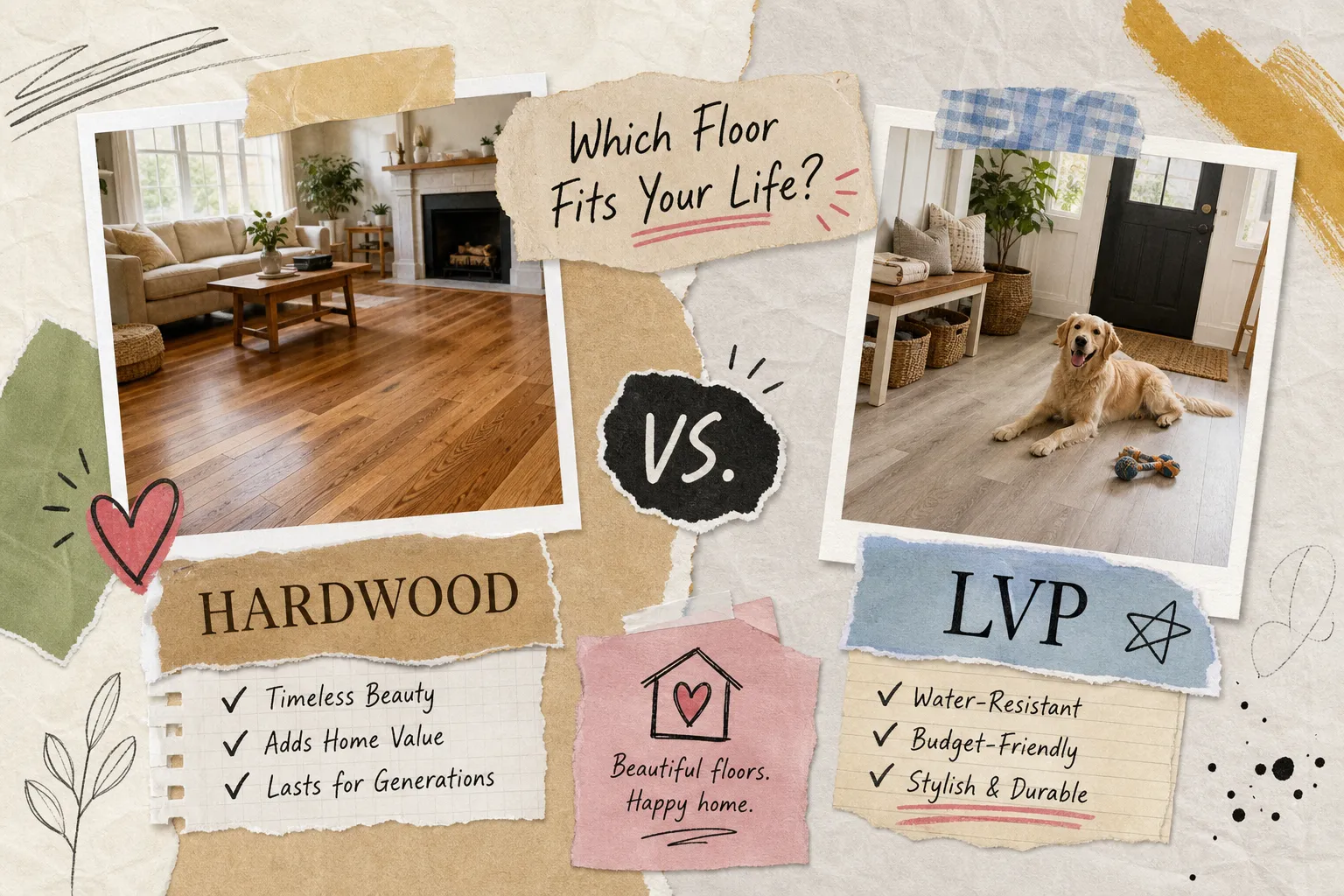
Neither floor wins across the board. LVP wins on upfront cost, moisture resistance, and low-maintenance living. Hardwood wins on aesthetics, long-term refinishing value, and resale premium. The right choice depends on the room, your household, and your plans for the property — and the best way to decide is seeing both in your own home.
Hardwood vs. LVP is the comparison that comes up in nearly every remodeling conversation, and for good reason. Both are genuinely excellent flooring options, and neither one wins across the board. The right choice depends on where the floor is going, who lives in the home, what the budget looks like, and what you plan to do with the property down the road.
At Floors and Beyond, we walk through this hardwood vs. LVP comparison during almost every free in-home consultation. After 35+ years working in Northern Virginia homes, we've learned one consistent truth: seeing both options in your space, under your lighting, next to your cabinets and walls, changes the decision more than any side-by-side chart ever could.
You still need the facts first, though. This article breaks down the factors that actually drive the decision — cost, durability, moisture resistance, aesthetics, and resale value — plus what to expect from installation on each side.
Hardwood
- Timeless beauty and real wood grain
- Adds home value at resale
- Lasts for generations — refinish instead of replace
LVP
- 100% waterproof — basements, baths, kitchens
- Budget-friendly and scratch-resistant
- Stylish, durable, and fast to install
| Factor | Hardwood | LVP |
|---|---|---|
| Installed cost | $6–$15+ / sq ft | $5–$10 / sq ft |
| Lifespan | 50–100 years; refinishable 4–8 times | 20–25 year warranties typical; replaced when worn |
| Moisture | Not for below-grade; engineered is humidity-tolerant | 100% waterproof |
| Resale | ~118% ROI new, ~147% refinished; 2.5–5% price premium | Neutral to slightly positive; ~50–70% ROI |
| Installation | 2–5 days plus acclimation and strict prep | 1–4 days; click-lock is fastest |
Hardwood vs. LVP: What You'll Actually Pay per Square Foot
Cost is usually the first question, and the answer is more nuanced than most people expect.
In Northern Virginia specifically, all-in flooring cost per square foot for LVP often starts around $5–$7, while engineered hardwood runs $8.50–$11 and solid hardwood $9–$11.
The cost difference between LVP and wood products comes from materials, not from the quality of the installation work itself. A well-installed 20-mil LVP floor is just as professional a job as hardwood. One real-world distinction worth knowing: hardwood sometimes requires additional acclimation time, moisture barriers, and subfloor leveling that add to the overall project cost. LVP is more forgiving on prep requirements, which keeps labor costs tighter. That's not a knock on hardwood. It's just a factor worth building into your budget conversation upfront.
Hardwood vs. LVP: Durability and Lifespan
One floor is refinished when it wears. The other is replaced.
LVP durability is measured by wear layer thickness in mils. Entry-level products run 6–8 mil. Standard residential LVP is typically 12 mil, carrying warranties of roughly 20–25 years. Heavy-use products at 20 mil or above often come with lifetime residential coverage and qualify for commercial-grade applications. For homes with kids and pets, 20 mil is the threshold worth considering; 12 mil is the minimum for a busy family home.
Solid hardwood's durability story is different. Standard 3/4-inch solid hardwood can be sanded and refinished 4–8 times over its lifetime, typically every 7–10 years depending on wear. That means the floor can look brand new again rather than needing replacement. A well-maintained solid hardwood floor can genuinely last 50–100 years. Engineered hardwood's refinishing potential depends on veneer thickness; thinner veneers in the 2–3 mm range may allow only one refinishing cycle, while thicker veneers allow more.
In everyday use, LVP resists surface scratching well but can dent under heavy point loads like furniture legs or appliances. Hardwood scratches more visibly but responds well to restoration. The fundamental difference comes down to this: when hardwood wears, you refinish it. When LVP wears through its wear layer, you replace it. A busy household with dogs, for example, may find LVP's scratch resistance more practical room by room, while a formal living room on an upper level may be exactly where hardwood earns its keep for decades.
Moisture Resistance: Which Rooms Each Floor Can Handle
This is where the comparison becomes most clear-cut.
LVP is 100% waterproof at the core. Its synthetic construction doesn't swell, warp, or delaminate from water exposure, making it suitable for bathrooms, laundry rooms, kitchens, and basements without concern. For any room that regularly sees moisture, LVP removes the guesswork entirely.
Solid hardwood is not recommended for below-grade installations or high-moisture environments. It expands and contracts with humidity, and persistent moisture causes cupping, crowning, and gapping. Engineered hardwood handles humidity swings better than solid because of its cross-ply core construction, and it can work over concrete slabs with proper moisture barriers. Even so, engineered hardwood is not waterproof, and standing water or prolonged moisture exposure will damage it.
It comes up constantly, especially in the older homes across Prince William and Fairfax County. If the space is below grade, LVP is the safe default. Engineered hardwood can work in a finished, climate-controlled basement with documented slab moisture testing, a proper vapor barrier, and no history of water intrusion — but for rental properties, investment homes, or any basement where moisture history is uncertain, LVP is the straightforward answer.
Aesthetics: What Each Floor Actually Looks and Feels Like
The visual gap is smaller than it was five years ago — but hardwood's depth is still real.
Solid and engineered hardwood deliver real wood grain, natural variation, and a warmth underfoot that no vinyl product fully replicates at close range. That's simply the honest assessment. LVP manufacturing has improved significantly, and high-end luxury vinyl plank now features embossed textures, wider planks, and realistic grain patterns that read well from standing height — but hardwood's depth, warmth, and sound underfoot remain distinctive to anyone paying close attention.
There's also an acoustic difference worth factoring in. Hardwood over a wood subfloor feels solid and sounds warmer underfoot. LVP can feel slightly hollow or soft without a quality underlayment beneath it, and sound transmission between floors is more pronounced. For homeowners who are sensitive to that underfoot feel, or who are installing on an upper level, this distinction matters.
Photos on a website can't show you how either floor reads in your specific lighting conditions, against your wall colors, or beside your cabinetry. That's exactly why the team at Floors and Beyond brings samples of both hardwood and vinyl plank flooring directly to your home during a free in-home consultation. Seeing both options side by side in your own light is the step that makes the decision clear.
Resale Value: Which Floor Gives You a Better Return
The data here points clearly in one direction.
Homes with hardwood floors consistently sell for 2.5–5% more than comparable homes without them, and buyer surveys show hardwood remains the most aspirational flooring feature, particularly in main living areas and higher-priced homes.
The case for LVP on resale is more modest — with ROI estimates landing in the 50–70% range based on available cost-vs-value data. That lower figure isn't necessarily a bad deal: LVP costs less to install, and in moisture-prone rooms where hardwood can't go, it's still a meaningful upgrade over dated carpet or sheet vinyl. The key distinction is that LVP rarely commands a price premium the way hardwood does.
Your home's price point shapes the answer significantly. In higher-end Northern Virginia markets like Fairfax or Loudoun County, buyers at the upper end of the market expect hardwood in main living areas, and its absence can become a negotiating point at listing. In rental properties, starter homes, or rooms below grade, LVP delivers solid performance and durability without the premium homeowners may not recover.
Installation: What to Expect Before the First Plank Goes Down
Prep requirements differ more than most homeowners expect.
Nail-down or staple-down over a wood subfloor. A full install, including acclimation, runs 3–5 days minimum.
Nail-down, glue-down, or floating — including over concrete slabs. Typically installs in 2–3 days once the subfloor is ready.
Click-lock is the fastest method available. A single room can go down in a day; multi-room projects wrap in 2–4 days.
Solid hardwood carries strict moisture testing and acclimation requirements before installation begins. Subfloor flatness is non-negotiable: no more than 3/16 of an inch variation over a 10-foot span. LVP is more forgiving on minor subfloor imperfections than hardwood, but it still needs a flat, clean, and dry surface, especially for glue-down applications. Glue-down LVP requires more exacting surface prep but delivers a more solid, permanent result in high-traffic or commercial-use areas.
Regardless of which flooring you choose, a professional pre-installation process includes subfloor moisture testing, flatness verification, and identifying any areas that need leveling or repair. Skipping that step is where most flooring problems originate, no matter which product is going down. A professional crew addresses all of it before the first plank ever hits the floor.
Making the Call: Hardwood vs. LVP for Your Home
There's no universal winner — there's the right floor for each room.
LVP wins on upfront cost, moisture resistance, and low-maintenance living. Hardwood wins on aesthetics, long-term refinishing value, and resale premium. The right choice depends on the specific room, your household's lifestyle, and what you value most from your floors over the next 10 to 20 years.
The best way to make that call isn't reading a comparison article — it's seeing both options in your actual home. At Floors and Beyond, we bring samples of hardwood and luxury vinyl plank directly to your door, take precise measurements, and provide an all-inclusive estimate with no hidden costs, all during a free in-home consultation. No guessing, no surprises, no pressure.
See both floors in your own light.
Floors and Beyond brings hardwood and LVP samples to your home, measures the space, and gives you an all-inclusive estimate — all during a free in-home consultation.
Schedule Your Free In-Home Consultation



