
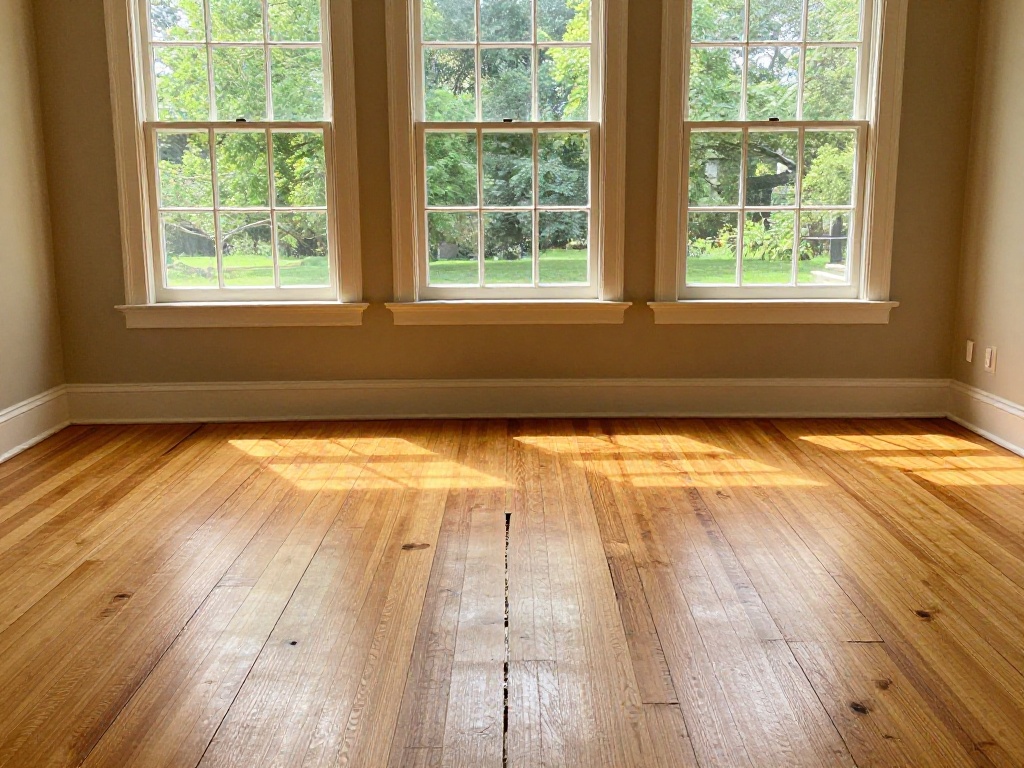
Why Your Hardwood
Gaps in Winter and
Swells in Summer.
And what to do about it — without panicking.
Every January, Floors and Beyond gets a version of the same call. A homeowner in Fairfax, Loudoun, Prince William, or Arlington County has noticed that the gaps between their hardwood floor planks have grown. Some of them can fit a coin in there now. They want to know if something is wrong, whether this is covered under warranty, and how much it's going to cost to fix. The answer, in almost every case, is the same: nothing is wrong. Your floors are doing exactly what hardwood floors do in a Northern Virginia winter.
And every July, we get the other version. The floors seem tighter than usual. In a few spots there's a slight ridge where planks meet. Is it buckling? Is it a problem? Again, in most cases: no. Your floors are doing exactly what hardwood floors do in a Northern Virginia summer.
Wood moves with the seasons. It has for as long as people have been using it to build things. Understanding why — in plain language, without the jargon — is the difference between spending the next ten years anxious about your floors and spending them at peace with how they work.
The Simple Science of Why Wood Moves
Hardwood is a hygroscopic material. That's a technical word for a simple idea: it absorbs and releases moisture from the surrounding air. When the air is humid, wood absorbs moisture and expands. When the air is dry, wood releases moisture and contracts. This isn't a flaw or a failure — it's a fundamental physical property of wood that cannot be engineered away. Every species of hardwood does this. Every finish slows it slightly but doesn't stop it. Every floor you've ever walked on has been doing this continuously since the day it was installed.
The amount of movement depends on three things: the wood species (some expand and contract more than others), the direction of the grain relative to the plank orientation, and — most importantly for a Northern Virginia homeowner — the size of the humidity swing between the driest and most humid conditions the floor experiences over the course of a year.
This is where our region matters. Northern Virginia sits in a climate zone with one of the widest seasonal humidity ranges of any major metropolitan area in the country. Our summers can reach outdoor relative humidity of 85–90%. Our winters, with heating systems running continuously, can push indoor humidity below 25%. That is a 60-percentage-point swing — and every point of that swing is something your hardwood floors feel and respond to.
The Key Number
"The target range for solid hardwood floors is 35–55% relative humidity year-round. Northern Virginia's seasons push well outside this range in both directions without active management. The seasonal movement you see is the floor's physical record of those excursions — a faithful log of what the air in your home has been doing."
Your Floor Through the Year — Season by Season
Here is what is actually happening inside your hardwood floors as the Northern Virginia calendar turns — and what you should expect to see at each stage.
December through February
Typical indoor humidity with heating running · Fairfax, Loudoun, Prince William, Arlington
This is gap season. The heating system running continuously pulls moisture out of the air — and out of your floors. As the wood dries, it contracts. Each plank gets slightly narrower. The space where adjacent planks meet — which was essentially invisible in more humid weather — becomes a visible gap. In a typical Northern Virginia winter without a humidifier, these gaps can be a millimeter or two wide in narrow-strip floors. In older homes with wider planks, they can be wider.
This is normal. This is seasonal movement working exactly as it should. The planks have not separated structurally. Nothing has come loose from the subfloor. The floor will return to its original appearance when humidity rises in spring.
March through May
Rising outdoor humidity · Heating systems transitioning · Pollen season
The gaps close. As outdoor humidity rises and the heating system runs less, the indoor air gets more moisture — and the floors reabsorb it. You'll watch over the course of a few weeks in March and April as the gaps that worried you in January quietly disappear. The planks expand back toward their summer dimensions. By May, most Northern Virginia hardwood floors look essentially the same as they did the previous September.
Spring is also when Floors and Beyond gets calls from homeowners who noticed gaps all winter and assumed the worst — then were surprised to see them close on their own. This is the floor's self-correction. It is not a coincidence. It is wood doing exactly what it has done every year since installation.
June through August
Peak humidity season · Highest moisture stress on hardwood
Summer is the other end of the movement cycle. Outdoor humidity in Northern Virginia's June-through-August window regularly reaches 80–85%. Even with air conditioning, indoor humidity in many homes without active humidity management climbs into the 65–75% range — well above what hardwood floors prefer. The wood absorbs this moisture, expands, and the planks push against each other.
In well-maintained floors with proper expansion gaps around the perimeter, this pressure is absorbed without incident. In floors that were installed tight, or that have been subjected to excessive moisture without any management, the summer expansion can create slight ridging at plank edges — the early sign of what's called cupping. A small ridge where planks meet that appears in July and flattens by October is most likely seasonal. A ridge that persists, grows, or appears in multiple areas simultaneously is worth a look from Floors and Beyond.
September through November
Transitioning toward drier conditions · The floor's sweet spot
Autumn is the most comfortable season for your hardwood floors. Outdoor humidity drops from summer peaks, heating systems haven't yet taken indoor air below the ideal range, and the floor sits close to its equilibrium state — the moisture content at which it neither expands nor contracts significantly. This is the window when floors look their most stable, when seasonal gaps are smallest, and when any persistent issues that aren't seasonal movement become most clearly visible.
If something looks wrong with your hardwood floors in October — a gap that hasn't closed, a ridge that hasn't flattened, a soft spot or squeak that developed over summer — autumn is the time to have Floors and Beyond take a look. What you're seeing in October is close to ground truth. It isn't seasonal noise.
Normal Movement vs. When to Call Us
The hardest part of living with hardwood floors is knowing what to worry about and what to let go. Here is the honest framework Floors and Beyond uses to answer that question.
✓ Normal — Let It Go
- Thin gaps in winter that close by spring
- Slight tightness or minor ridging in peak summer that resolves in fall
- Seasonal squeaking that appears and disappears with humidity changes
- Uniform gaps across the floor — same width in every board
- Gaps that have appeared and closed in the same pattern for several years
- Floors that look different in January vs. July but stable within each season
→ Worth a Call to Floors and Beyond
- Gaps that don't close after spring arrives
- Cupping — edges of planks consistently higher than centers — that persists into fall
- A gap or ridge that grows over multiple seasons rather than cycling
- Dark staining around gaps near exterior doors or walls
- Soft or spongy areas underfoot that weren't there before
- A plank or section that sounds distinctly different from the surrounding floor
- Gaps that are dramatically wider in one area than everywhere else
The diagnostic principle: seasonal movement is symmetrical and reversible. It opens in winter and closes in spring. It expands in summer and settles in fall. If the movement is only going in one direction — only opening, only raising — something beyond seasonal humidity variation is at work. That's when the condition stops being a climate story and starts being a structural one.
The Habits That Keep Seasonal Movement in Check
You cannot stop seasonal movement — no one can, and no finish or sealant will prevent it completely. What you can do is narrow the range of movement by managing your home's humidity more consistently. This is the single most effective thing a Northern Virginia hardwood floor owner can do for their floors.
You cannot manage what you cannot measure. A digital hygrometer shows you the real-time relative humidity in each room. When it drops below 35% in winter or climbs above 55% in summer, you have an actionable number — not a guess. This is the foundational tool for every Northern Virginia hardwood floor owner.
A furnace humidifier — plumbed into the HVAC system — adds moisture to the heated air your system distributes through the house. It's the most effective way to keep indoor humidity from dropping below 35% when the heat is running. A console humidifier works for single rooms. The goal is keeping the floor in its target range so the gaps stay small.
Air conditioning removes moisture from the air as it cools — it's a dehumidifier as much as a cooler. Running it consistently through summer maintains more stable indoor humidity than cycling it on and off or turning it off when you leave for work. Consistency is the key word. Dramatic humidity swings are harder on floors than sustained moderate humidity.
A wet mop introduces concentrated, repeated moisture directly to the floor surface and into the seams between planks. Over years, this accelerates the baseline moisture content of the floor beyond what ambient humidity alone would produce — compressing the expansion and exaggerating the contraction. Damp microfiber, not wet mop. Always.
Some homeowners, alarmed by winter gaps, fill them with wood filler or caulk. This is a mistake. The gaps will close in spring — and the filler, which doesn't compress the way wood does, creates a ridge or buckling pressure as the planks return to their expanded state. Seasonal gaps should be observed, not filled. If they don't close by May, that's when to call Floors and Beyond.
If summer humidity has caused slight cupping — the edges of planks rising above their centers — the natural instinct is to sand it flat. This is one of the most common and most expensive mistakes in hardwood floor care. Sanding a wet, cupped floor removes the raised edges. When the floor dries and contracts, the center becomes high — a condition called crowning that cannot be corrected without a full resand. If you see cupping, control the humidity. Do not sand until the floor has fully returned to its normal moisture content.
Not sure if what you're seeing is seasonal movement or something that needs attention? Floors and Beyond offers free floor assessments across all four counties.
Book a Free AssessmentA Note on Northern Virginia Specifically
Floors and Beyond has been working in homes across Fairfax, Loudoun, Prince William, and Arlington Counties for nearly 40 years. In that time we have watched Northern Virginia's hardwood floors cycle through thousands of seasons. A few things stand out about our region that homeowners here should know.
The seasonal humidity swing in Northern Virginia is wider than in most comparable markets. Homeowners who move here from drier parts of the country — the Southwest, the Mountain West — are often unprepared for how much their floors move. And homeowners who move here from more uniformly humid climates sometimes find Northern Virginia's winters surprisingly harsh on floors that never had to deal with prolonged heating-season dryness before.
Our older housing stock — the colonials, the split-levels, the ranches built in Fairfax County in the 1960s, 70s, and 80s — often has original solid hardwood that has cycled through 40 or 50 seasons. These floors have developed a stability and pattern of seasonal movement that newer floors haven't yet settled into. They gap and close in predictable ranges. They know their rhythms. Part of caring for an older Northern Virginia hardwood floor is learning those rhythms and working with them rather than against them.
The newer construction in Loudoun and Prince William Counties — much of it with engineered hardwood or builder-grade solid hardwood — has different seasonal characteristics. Engineered hardwood's cross-ply construction reduces seasonal movement significantly compared to solid hardwood. Builder-grade solid hardwood with thinner planks moves less than wider-plank floors of the same species. If your floors aren't moving as dramatically as a neighbor's, it may simply be that your floors are made of different materials or were milled differently — not that your HVAC is performing better.
Frequently Asked Questions
How much gap in my hardwood floors is normal in winter?
For narrow-strip hardwood (2-1/4 inch planks, common in Northern Virginia colonials), gaps of 1–2mm are well within normal seasonal range during dry winter conditions. For wider plank floors, proportionally more movement is expected. The key test is not the gap size but the pattern: uniform gaps across the floor that close by late spring are seasonal. Gaps concentrated in one area, gaps that don't close, or gaps that have grown larger over multiple winters warrant a professional assessment.
Should I fill the gaps in my hardwood floors?
If the gaps appear in winter and close by spring — no. Never fill seasonal gaps with wood filler, caulk, or any rigid material. The floor will expand again and the filler will either get pushed out or create buckling pressure. If gaps are present year-round — visible in both winter and summer, never fully closing — that is a different situation. Permanent gaps in warmer months may indicate that the floor was installed without adequate expansion room, that the floor has experienced drying damage, or that subfloor issues are creating localized movement. Call Floors and Beyond for an assessment rather than reaching for the filler.
My floor looks cupped in summer. Is it ruined?
Not necessarily — but act quickly. Mild cupping caused by seasonal humidity that hasn't persisted for more than a few weeks often resolves fully as conditions normalize in fall. The critical step is: do not sand a cupped floor. Control the humidity, give it time, and reassess in October. If the cupping has not resolved by the time indoor humidity is back in the 35–55% range, call Floors and Beyond. Cupping that doesn't reverse after humidity normalizes indicates something beyond seasonal movement — often a subfloor moisture source or a previous moisture event that has altered the floor's baseline moisture content.
Does engineered hardwood have the same seasonal movement as solid hardwood?
Much less. Engineered hardwood's cross-ply construction — multiple layers of wood oriented in alternating grain directions — significantly limits the dimensional movement that makes solid hardwood so responsive to humidity changes. You'll see some seasonal movement in engineered hardwood, particularly in Northern Virginia's extreme conditions, but it will be substantially less dramatic than in solid hardwood of the same species. This reduced movement is one of the primary practical advantages of engineered hardwood in our climate.
My hardwood floors squeak in winter but not summer. Is this seasonal?
Almost certainly. Squeaking that appears and disappears with the seasons is typically caused by planks that have contracted enough to allow slight movement against neighboring planks or against the subfloor fasteners — movement that disappears when the floor re-expands in spring. Persistent squeaking year-round, or squeaking that has developed recently and is getting worse, indicates subfloor fastening issues or structural movement that isn't seasonal. Floors and Beyond can usually distinguish the cause during a simple floor walk — no invasive work required for the initial assessment.
Not Sure If What You're Seeing Is Normal?
Floors and Beyond has seen 40 years of Northern Virginia seasons. We can tell you in minutes whether what you're looking at is your floor doing its job — or something that actually needs attention. Free assessment, honest answer. Serving Fairfax, Loudoun, Prince William, and Arlington since 1987.
Book a Free Assessment



