
Floor Restoration Guide · Northern Virginia
Hardwood Floor Refinishing in Northern Virginia: A Field Guide for Pre-War and Post-War Homes
Most NoVA hardwood floors built before 1970 can be refinished at least once. Many can be refinished three or four times. The hard part is knowing which subfloor you actually have, which neighborhood pattern you live in, and which finish will survive a Virginia summer.
Hardwood floor refinishing in Northern Virginia is almost always worth pursuing before replacement, because the majority of pre-war homes in Del Ray, Lyon Village, Waverly Hills, Rosemont, Old Town Alexandria, Seminary Hill, and Clarendon sit on wood joist subfloors with diagonal plank beneath original solid hardwood that has decades of refinishability remaining. Post-war homes in Burke, Springfield, and Fairfax — built on plywood or OSB over wood joists — are also strong refinish candidates. The decision should always begin with a subfloor assessment and a refinishability test, not a product sample. Floors and Beyond VA has refinished Northern Virginia hardwood since 1987 using in-house crews, never subcontractors.
Why Northern Virginia Is Hardwood Country
Northern Virginia has one of the densest concentrations of original-growth hardwood flooring on the East Coast. That sounds like a marketing line until you stand in a Del Ray bungalow built in 1922 and realize the floor under three layers of linoleum is quarter-sawn white oak that has not been touched in a hundred years. It happens more often than most homeowners expect.
The pattern repeats across the region. Pre-war neighborhoods — Del Ray, Lyon Village, Waverly Hills, Rosemont, Old Town Alexandria, Seminary Hill, Clarendon — were framed with wood joists and diagonal plank subfloors, then floored with solid 3/4" hardwood. Post-war neighborhoods like Burke, Springfield, and older Fairfax County followed with plywood or OSB over wood joists, still accepting solid hardwood. Even post-2000 construction in Ashburn, Woodbridge, Herndon, and Sterling, where concrete slabs dominate, often has engineered hardwood in the public spaces — and that engineered product has a refinishable veneer if the wear layer is thick enough.
The implication is simple. Before any homeowner in Northern Virginia replaces a hardwood floor, the existing floor should be tested for refinishability. Most of the time, refinishing is the correct answer — both economically and because original old-growth material is denser and more dimensionally stable than almost anything available today.
The Refinish-First Principle
Floors and Beyond VA operates on a refinish-first philosophy. When a crew walks into a pre-war NoVA home, the first question is not "what product would you like to install?" — it is "can we save what is already here?" This is not nostalgia. Original hardwood installed before 1960 came from slower-growth trees with tighter grain, denser cell structure, and superior dimensional stability. New replacement boards, even when graded and milled to specification, rarely match that quality.
Refinishing also preserves the historical character that gives neighborhoods like Del Ray and Old Town Alexandria their value. A 1925 white oak floor with the original patina, lightly screened and recoated, sells a house differently than a brand-new prefinished floor. Buyers in Northern Virginia recognize the difference. Appraisers do too.
The refinish-first lens also changes the conversation around cost. Refinishing is typically a fraction of replacement cost, produces less dust and disruption, and can be completed in a single day for an average-sized room. When a floor can be saved, saving it is almost always the correct call. The harder question — and the one this guide spends the most time on — is how to know whether a floor can actually be saved.
The Subfloor-First Decision Framework
Before aesthetics enter the conversation, the subfloor determines what is even possible. Floors and Beyond VA uses a subfloor-first framework on every refinishing assessment, because the wrong subfloor can turn a straightforward refinish into a tear-out.
There are three subfloor patterns across Northern Virginia, and each one changes the refinishing calculus. The first is wood joist with diagonal plank — common in pre-war Alexandria and Arlington. This is the strongest subfloor for hardwood refinishing because it accepts nails, allows the floor to breathe, and historically carries solid 3/4" material that has multiple refinish cycles remaining. The second is plywood or OSB over wood joists, found across post-war Burke, Springfield, and Fairfax. This is also a refinish-friendly subfloor, though fastener pull-out is more common and the installer must verify the floor is adequately fastened before sanding begins. The third is concrete slab — present in nearly all post-2000 construction in Ashburn, Woodbridge, Herndon, and Sterling. Concrete slabs do not hold solid hardwood without an engineered adaptation, which means refinishability depends entirely on the wear layer of whatever engineered product was originally installed.
A refinish-first assessment always begins by identifying which of these three patterns is underfoot. Until that is known, no recommendation is reliable.
NoVA Neighborhood Patterns: Pre-War
The pre-war neighborhoods of Northern Virginia are where refinishing pays the largest dividends. In Del Ray, Lyon Village, Waverly Hills, Rosemont, Old Town Alexandria, Seminary Hill, and Clarendon, homes built between roughly 1900 and 1940 were framed with old-growth lumber and floored with solid 3/4" hardwood — typically red or white oak, occasionally maple, occasionally heart pine in the oldest homes. The subfloor is wood joist with diagonal plank, which is the most stable base a hardwood floor can sit on.
These floors are often hidden. Many Del Ray and Old Town homes were carpeted in the 1970s, sheet-vinyled in the 1980s, or laminated over in the 2000s. Beneath those layers, the original hardwood is frequently intact, sometimes with pet stains and water damage that a professional sanding sequence can address. Floors and Beyond VA has pulled up dozens of floors in Alexandria and Arlington to find material that no one in the household knew existed.
When a pre-war floor is sound — meaning no significant structural deflection, no extensive pet or water damage, and at least a quarter-inch of wood above the tongue — refinishing is the correct answer. Period. Replacement should not be on the table until those three conditions have been verified and one of them has failed.
NoVA Neighborhood Patterns: Post-War
Burke, Springfield, Fairfax, and the older stretches of Fairfax County were developed largely between 1945 and 1985, with wood-frame construction on plywood or OSB subfloors. The original flooring in these homes is typically 3/4" solid oak — often 2-1/4" strip, sometimes 3" or 4" plank — and the subfloor accepts refinishing well. These neighborhoods are where Floors and Beyond VA does most of its sand-and-refinish work.
The most common refinishing problems in post-war NoVA homes are not problems with the wood itself. They are problems with what has been layered on top of it. Sheet vinyl glued down in the 1980s leaves adhesive residue that requires aggressive scraping and multiple sanding passes. Laminate floating floors installed in the 2000s often leave carpet-tack indentations that sand out cleanly. Carpet pad residue and pet stains are the most common reason a post-war floor cannot be fully saved — but even then, board replacement is usually a more appropriate response than full tear-out.
If you live in Burke, Springfield, or Fairfax and you are uncertain whether your floor is refinishable, the answer is almost certainly yes. A field assessment takes less than an hour.
NoVA Humidity and Seasonal Movement
Northern Virginia's climate is rough on hardwood. Winter humidity routinely drops below 30 percent indoors, driving hardwood boards to shrink and open gaps between planks. Summer humidity in the DC metro area frequently exceeds 70 percent — sometimes 90 percent during July and August — which causes the same boards to swell and close those gaps, sometimes crowning or cupping if the moisture differential is severe.
This seasonal movement is normal, not a defect. What matters is whether the floor was installed with adequate acclimation, finished properly, and maintained at a stable indoor humidity. A refinished floor that is properly sealed will move less visibly than an uncoated one, because the finish slows moisture vapor transmission in both directions. Pre-war homes with older, tighter-grain material also move less than newer floors, because the cell structure is denser.
If a Northern Virginia homeowner is reflooring rather than refinishing, the humidity swing should drive product selection toward white oak first — its tighter grain handles the seasonal movement better than red oak — and away from wide-plank solid products, which show movement more dramatically. Wire-brushed or matte finishes also hide seasonal movement better than high-gloss, because the texture diffuses the visible reflections that crown cupping would otherwise highlight.
Why White Oak First
When a floor has been refinished as many times as it can be, replacement enters the conversation. At that point, the species matters as much as the product. Floors and Beyond VA specifies white oak as the first-choice species across Northern Virginia, for three reasons.
First, white oak has a tighter grain than red oak. That tighter grain means the floor absorbs less moisture vapor in a Virginia summer, shrinks less in a Virginia winter, and shows fewer visible gaps across the year. Second, white oak is more dimensionally stable across humidity swings — measurable, not anecdotal. Third, white oak takes wire-brushed and matte finishes more gracefully than red oak, because the contrast between the softer springwood and harder summerwood produces a texture that masks wear, dents, and seasonal movement over time.
High-gloss finishes on a wide-plank red oak floor look beautiful in a showroom and punishing in a Springfield family room after one winter heating season. The preference for matte and wire-brushed finishes in Northern Virginia is not aesthetic — it is climate-driven.
How to Tell If Your Hardwood Can Be Refinished
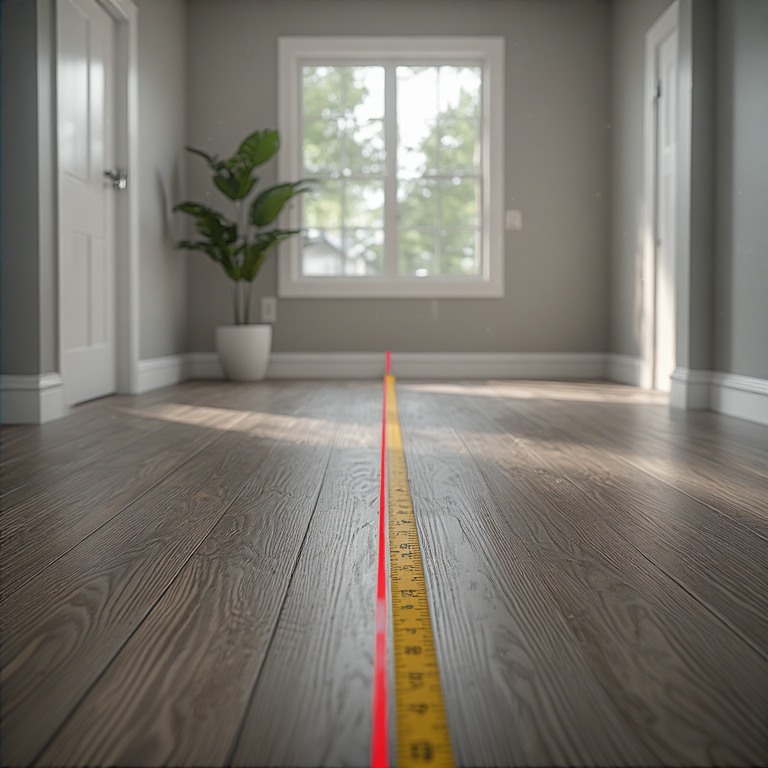
The single most useful test a homeowner can do before calling a contractor is to measure the wear layer — the wood remaining above the tongue of each board. Solid 3/4" hardwood starts with roughly 1/4" of usable wood above the tongue. Every full sanding removes about 1/32" to 1/16" of material, depending on how aggressive the cut needs to be. That means an original floor that has never been refinished typically has three to four refinish cycles in it. A floor that has been refinished twice may have only one more cycle left.
The simplest field test is to find a floor register or a transition strip where a board end is exposed. Measure from the top of the board to the top of the tongue. Anything above 1/8" is refinishable. Anything below 1/16" is not. Between those two numbers, the call depends on the condition of the boards, the depth of any stains, and the skill of the sanding crew.
Other signals matter too. Floors with widespread cupping deeper than 1/16" may need to flatten before sanding, which can require additional time and a more careful sanding sequence. Floors with extensive pet stains that have penetrated below the tongue may need board replacement rather than full refinishing. Floors with structural deflection — a floor that bounces when you walk on it — need subfloor repair before any sanding begins. None of these are reasons to replace; they are reasons to call a professional who knows the difference.
The Refinishing Process, Briefly
A professional hardwood refinish in Northern Virginia follows a predictable sequence. The room is sealed, the floor is fastened down — every loose board nailed or screwed to the subfloor — and the sanding sequence begins. A drum sander takes the first cut, usually with 36- or 40-grit paper to remove the old finish and level the boards. A second pass with 60- or 80-grit removes the scratches from the first pass. An edger handles the perimeter. A final pass with 100- or 120-grit prepares the floor for finish. Between each grit, the floor is vacuumed and inspected.
Water-popping — wiping the floor with a damp cloth to raise the grain — is the step that separates a professional refinish from a DIY one. It opens the wood's pores, allowing the finish to penetrate evenly and producing a deeper, more consistent color. On white oak, water-popping also brings out the natural character that gives a refinished NoVA floor its warmth.
Finish is then applied in two to three coats, with adequate drying time between each coat. The floor is walked-on-ready in 24 hours and furniture-ready in 48 to 72 hours, depending on the finish system used. Total job time for an average-sized room is one to two days of work plus curing time.
Finish Selection: Wire-Brushed, Matte, or High-Gloss
Finish selection is one of the few places where Northern Virginia homeowners consistently make the wrong call. High-gloss finishes are visually striking in a showroom and unforgiving in a home with kids, pets, red clay soil tracked in from a Loudoun backyard, and seasonal humidity movement. They show every scratch, every dust mote trapped in the finish, and every seasonal gap that opens between planks.
Floors and Beyond VA recommends wire-brushed or matte finishes for almost every Northern Virginia refinish. Wire-brushing removes the softer springwood from the surface, leaving the harder summerwood standing in slight relief. That texture diffuses light, hides scratches, masks dents, and makes seasonal movement nearly invisible. Matte finishes do similar work without the texture — they are the right call when a homeowner wants the look of an oil-finished European floor without the maintenance burden.
Satin is the middle ground. It is acceptable, but it shows more wear than matte over time. High-gloss is reserved for formal spaces with low traffic — and even then, only when the homeowner understands the maintenance commitment.
When Not to Refinish
Refinishing is not always the right answer. A floor with structural damage, extensive termite activity, severe water damage that has buckled the boards, or a wear layer below 1/16" cannot be saved. In those cases, replacement is appropriate — and the replacement decision should still be subfloor-first, climate-aware, and white-oak-first when solid hardwood is being reinstalled.
Floors and Beyond VA will not refinish a floor that cannot be saved properly. A refinish on a worn-out floor produces a floor that looks acceptable for six months and then shows every underlying defect. The correct call is to replace — and to do it with the same care, the same subfloor-first assessment, and the same in-house crew.
Why Floors and Beyond VA
Floors and Beyond VA has refinished Northern Virginia hardwood since 1987. Floors and Beyond, who leads the field assessments, has roughly forty years of experience on Virginia job sites — including pre-war restoration work in Old Town Alexandria, Del Ray, and Clarendon, and post-war refinishing across Burke, Springfield, and Fairfax. The crews are in-house. There are no subcontractors. Every refinishing job is staffed by Floors and Beyond VA employees, supervised on-site, and completed under a single point of accountability.
That structure matters because refinishing is unforgiving work. A crew that is rushed, unfamiliar with the floor, or not directly answerable to the company that sold the job will cut corners. In-house crews do not. They are paid to do the job correctly the first time, and they answer to the same person who answers to the homeowner.
Frequently Asked Questions
How do I know if my Northern Virginia hardwood floor can be refinished?
The simplest test is to measure the wear layer — the wood remaining above the tongue of each board. Find a floor register or transition strip where a board end is exposed, and measure from the top of the board down to the top of the tongue. Anything above 1/8" is refinishable. Anything below 1/16" is not. Floors and Beyond VA performs this test on every assessment, along with checks for cupping, pet stains, and structural movement.
How long does a hardwood refinish take in a typical NoVA home?
An average-sized room — roughly 200 to 300 square feet — takes one to two days of active work: sanding, water-popping, and two to three coats of finish. The floor is walk-on-ready in 24 hours and furniture-ready in 48 to 72 hours, depending on the finish system. Larger homes in Burke, Springfield, and Fairfax with multiple connected rooms may take three to four days total. Floors and Beyond VA provides a specific timeline after the field assessment.
Is refinishing better than replacement for older homes in Del Ray or Old Town Alexandria?
Almost always. Pre-war neighborhoods in Northern Virginia — Del Ray, Lyon Village, Waverly Hills, Rosemont, Old Town Alexandria, Seminary Hill, and Clarendon — sit on wood joist subfloors with diagonal plank beneath original solid hardwood. That material is denser and more dimensionally stable than almost anything available today. When it can be saved, saving it is the correct call — both economically and for the long-term value of the home.
Will my refinished floor cup or gap during Virginia summers and winters?
Seasonal movement is normal in Northern Virginia hardwood. Winter dryness opens gaps; summer humidity above 70 percent closes them. A properly sealed floor moves less visibly than an uncoated one. Selecting white oak with a wire-brushed or matte finish also masks seasonal movement, because the texture diffuses the visible reflections that would otherwise highlight cupping.
Floors and Beyond VA — Service Area
Floors and Beyond VA provides hardwood refinishing across the Northern Virginia region, including the cities and communities of Ashburn, Woodbridge, Herndon, Sterling, Leesburg, Reston, Springfield, Burke, Fairfax, Alexandria, and Arlington.
Fairfax County · Loudoun County · Prince William County · Arlington County
Schedule a refinish assessment directly with Floors and Beyond VA — in-house crews, no subcontractors, no pricing on the website.