Best Flooring by Room · Northern Virginia
Best Flooring by Room: A NoVA Subfloor-First Room Guide
The best flooring by room is not a single product applied uniformly. Each room has different requirements — moisture, traffic, slip resistance, sound absorption — and the right product for one room is often the wrong product for the next.
The best flooring by room in a Northern Virginia home: living room — solid 3/4" white oak with wire-brushed or matte finish (wood joist) or SPC LVP with 20-mil wear layer (slab); kitchen — porcelain tile with DCOF 0.42+ and Schluter Ditra membrane (wood joist) or SPC LVP (slab); bathroom — porcelain tile with DCOF 0.42+ and Schluter Ditra membrane; bedroom — nylon or triexta carpet with 8-lb density pad and 40 oz/yd² face weight; basement — SPC LVP regardless of above-grade subfloor; mudroom — SPC LVP or porcelain tile; hallway — solid white oak (wood joist) or SPC LVP (slab). Subfloor determines eligibility. In-house crews, no subcontractors, since 1987.
The Subfloor Determines Eligibility
Before selecting products by room, the subfloor determines what is even eligible. Floors and Beyond VA uses a subfloor-first framework on every assessment. Pre-war homes in Del Ray, Lyon Village, Waverly Hills, Rosemont, Old Town Alexandria, Seminary Hill, and Clarendon sit on wood joist with diagonal plank. Post-war homes in Burke, Springfield, and Fairfax sit on plywood or OSB over wood joists. Post-2000 homes in Ashburn, Woodbridge, Herndon, and Sterling sit on concrete slabs.
On wood joist subfloors, solid 3/4" hardwood is eligible for living rooms, dining rooms, hallways, and bedrooms. Engineered hardwood is also eligible. SPC LVP is eligible but rarely the right choice for primary living areas on a wood joist subfloor, because solid hardwood outperforms LVP over a 30+ year lifespan. Porcelain tile is eligible for kitchens, bathrooms, mudrooms, and laundry rooms, with a Schluter Ditra decoupling membrane required on a wood joist subfloor.
On concrete slabs, solid hardwood is not eligible without significant floor build-up. SPC LVP is the practical baseline for living rooms, dining rooms, hallways, and kitchens. Engineered hardwood with a thick wear veneer is the value upgrade. Porcelain tile is eligible for kitchens, bathrooms, mudrooms, and laundry rooms, installed directly on the slab after moisture vapor testing.
Living Room and Family Room
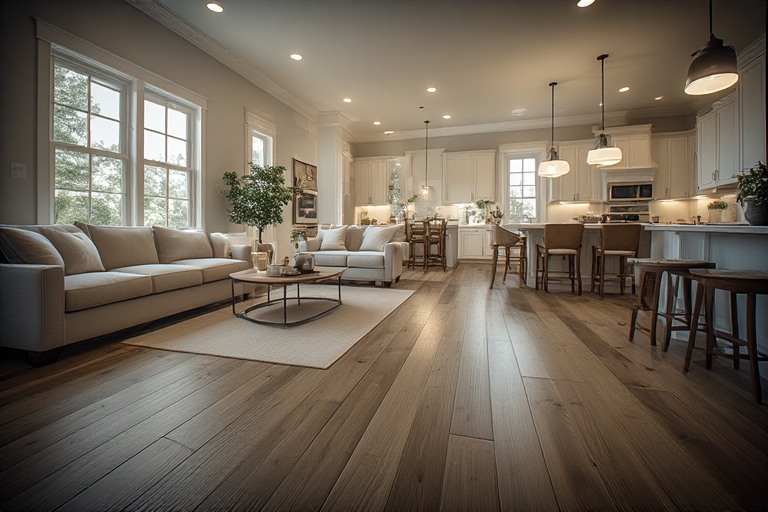
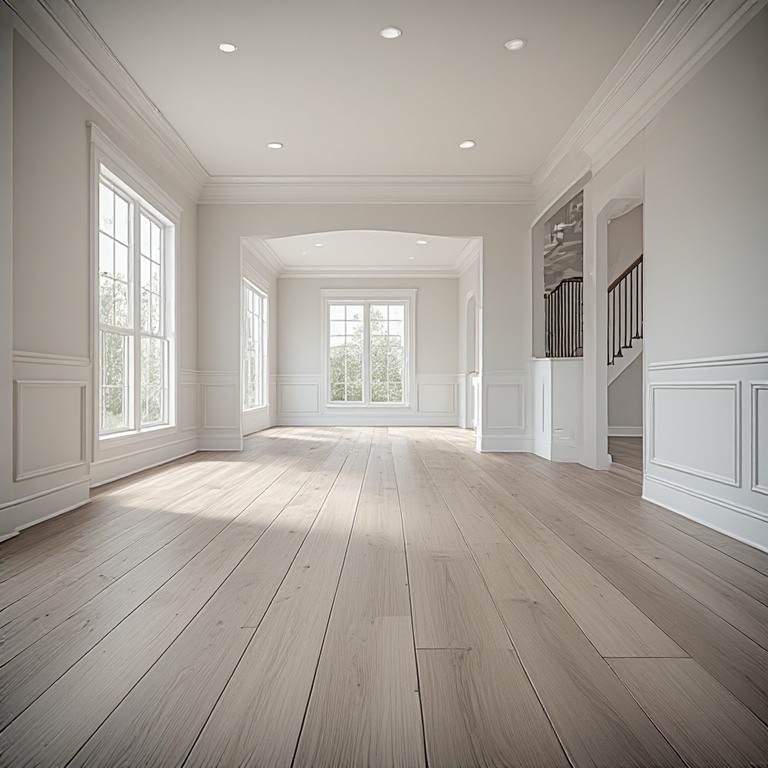
The living room and family room are the primary living areas where flooring choice contributes most to resale value and daily comfort. On a wood joist subfloor, the right product is solid 3/4" white oak with a wire-brushed or matte finish. White oak has a tighter grain than red oak, which means the floor absorbs less moisture vapor in a Virginia summer, shrinks less in a Virginia winter, and shows fewer visible gaps across the year. Wire-brushed or matte finishes hide scratches, dents, and seasonal movement.
On a concrete slab, the right product is SPC LVP with a 20-mil wear layer (the practical baseline) or engineered hardwood with a 3mm+ wear veneer (the value upgrade). Solid hardwood is not an option on a slab without significant floor build-up. The decision between SPC LVP and engineered hardwood depends on budget, expected tenure in the home, and resale value considerations.
If the existing floor is solid oak with a wear layer above 1/8", restoration is almost always the better investment than new installation. Floors and Beyond VA has found original hardwood under carpet in dozens of NoVA homes. Restoration is a fraction of the cost of new hardwood installation and preserves the original material that buyers in pre-war neighborhoods specifically reward.
Kitchen
The kitchen has spills, water, grease, dropped cookware, and frequent cleaning. The right flooring for a NoVA kitchen must handle all of these without permanent damage. On a wood joist subfloor, the right product is porcelain tile with DCOF 0.42+ and a Schluter Ditra decoupling membrane, or solid 3/4" white oak with a matte or wire-brushed finish (many NoVA homeowners prefer wood in the kitchen for visual continuity with the living room).
On a concrete slab, the right product is SPC LVP with a 20-mil wear layer, or porcelain tile with DCOF 0.42+. SPC LVP is the practical choice on a slab because the waterproof core handles spills and water without permanent damage. Porcelain tile is the most durable kitchen flooring on any subfloor, with a lifespan of 50+ years, but costs more upfront and requires more installation time.
The DCOF (Dynamic Coefficient of Friction) rating of 0.42 or greater is essential for kitchen floors because it provides slip resistance on wet surfaces. Anything below 0.42 is a slip hazard in a kitchen where water spills are routine. Porcelain is preferred over ceramic because it is denser and less porous, which makes it more resistant to staining and more durable under heavy use.
Bathroom
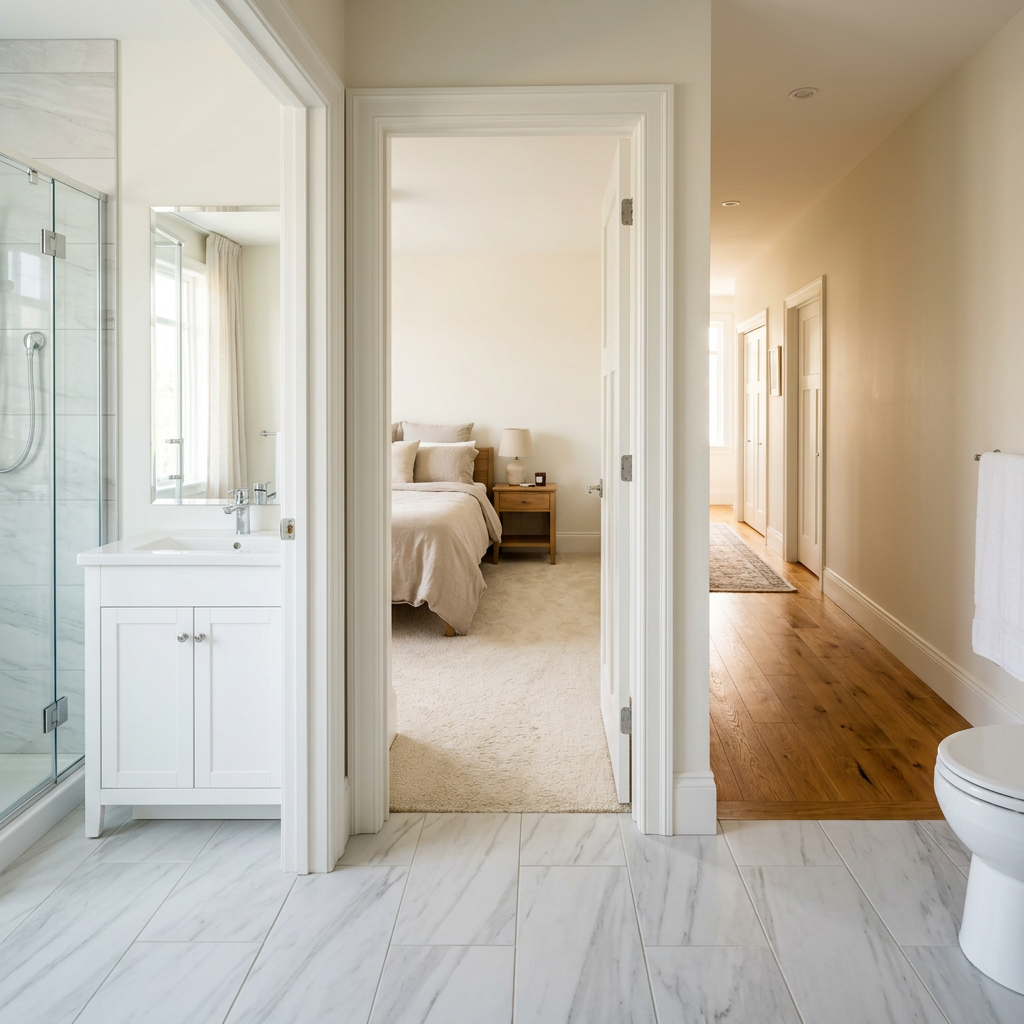
The bathroom has consistent moisture, water spills, and the need for slip resistance. The right flooring for a NoVA bathroom is porcelain tile with DCOF 0.42+ and a Schluter Ditra decoupling membrane on a wood joist subfloor. On a concrete slab, porcelain tile can be installed directly after testing the slab for moisture vapor transmission. Solid hardwood is not appropriate for bathrooms because the consistent moisture will cup and damage the wood over time.
The Schluter Ditra decoupling membrane is essential on a wood joist subfloor because it prevents cracks in the tile from subfloor movement. Wood joist floors flex slightly underfoot, and any tile installed directly on the subfloor will crack within a few years. The decoupling membrane absorbs the movement and prevents the cracks.
The DCOF 0.42+ rating is essential for bathroom floors because it provides slip resistance on wet surfaces. Bathrooms are the room where slip resistance matters most — anything below 0.42 is a serious slip hazard, particularly for children and older adults. Floors and Beyond VA does not install tile with a DCOF below 0.42 in any NoVA bathroom.
Bedroom
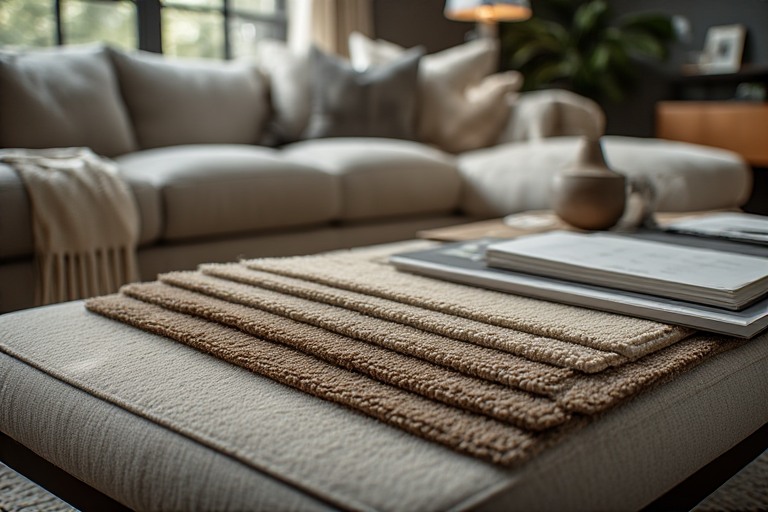
The bedroom is a lower-traffic area where comfort, warmth, and sound absorption matter more than durability. The right flooring for a NoVA bedroom is nylon or triexta carpet with an 8-lb density pad and 40 oz/yd² face weight minimum. Nylon is the gold standard for bedroom carpet because it is resilient, stain-resistant, and holds its shape under foot traffic. Triexta is a newer fiber that performs similarly to nylon but with better stain resistance — it is a reasonable choice for households with young children or pets.
The pad matters as much as the carpet. An 8-lb density pad is the minimum for primary bedroom areas — it provides the cushioning that allows the carpet to bounce back from foot traffic. A 6-lb pad, which is the builder-grade standard, will compress within a year and leave the carpet looking flat and worn regardless of the carpet quality. The face weight — 40 oz/yd² or greater for primary areas — determines how much fiber is in the carpet, which determines how long the carpet will look new under foot traffic.
Polyester is not specified for primary bedroom areas because it lacks the resilience to bounce back from compression. Hardwood in bedrooms is also a reasonable choice, particularly in pre-war homes where the original hardwood flows from the hallway into the bedrooms. The decision between hardwood and carpet in bedrooms depends on the neighborhood, the home's price point, and the buyer expectation.
Basement
The basement is a below-grade space where moisture is a constant concern, regardless of the above-grade subfloor type. Solid hardwood is not appropriate in below-grade NoVA spaces because the humidity differential is too severe and the failure risk is too high. The right flooring for a NoVA basement is SPC LVP with a 20-mil wear layer, because the waterproof core handles the moisture without absorbing it.
The SPC specification is the same as for above-grade slab homes: minimum 20-mil wear layer, 5mm total thickness or greater, waterproof core. The rigid SPC core handles the humidity differential and prevents the floor from telegraphing subfloor imperfections or separating at the seams. WPC and glue-down LVP do not perform as well in basement conditions.
Carpet is also a reasonable choice for finished basements, particularly with a moisture barrier pad and a synthetic fiber (nylon or triexta, not polyester). The carpet provides warmth and sound absorption in a below-grade space, but it requires more frequent cleaning in NoVA's humid climate. Tile is also eligible in basements, but the cold surface can be uncomfortable underfoot in winter.
Mudroom and Laundry Room
The mudroom and laundry room are wet areas where moisture, dirt, and frequent cleaning are routine. The right flooring for a NoVA mudroom or laundry room is SPC LVP with a 20-mil wear layer, or porcelain tile with DCOF 0.42+. The waterproof core of SPC LVP handles the moisture without permanent damage, and the dimensional stability prevents the floor from telegraphing subfloor imperfections.
On a wood joist subfloor, porcelain tile requires a Schluter Ditra decoupling membrane to prevent cracks from subfloor movement. On a concrete slab, porcelain tile can be installed directly after moisture vapor testing. Solid hardwood is not appropriate for mudrooms or laundry rooms because the consistent moisture will cup and damage the wood over time.
The mudroom is also a room where red clay soil from Loudoun and Prince William backyards tracks in on shoes and pets. The product spec needs to account for this — matte and embossed-in-register finishes hide soil and pollen better than smooth, glossy surfaces. The same logic applies to LVP finish selection in mudrooms.
Hallway
The hallway is a high-traffic area that connects rooms and serves as a visual transition. On a wood joist subfloor, the right product is solid 3/4" white oak with a wire-brushed or matte finish, flowing from the living room for visual continuity. On a concrete slab, the right product is SPC LVP with a 20-mil wear layer, or engineered hardwood with a thick wear veneer.
The hallway is also the room where existing original hardwood is most likely to be intact under carpet, because hallways are often carpeted for sound absorption. Floors and Beyond VA has found original solid oak under hallway carpet in dozens of NoVA homes. Restoration is a fraction of the cost of new hardwood installation and preserves the original material that buyers in pre-war neighborhoods specifically reward.
Why In-House Crews
Floors and Beyond VA does not use subcontractors. Every room-by-room installation — hardwood, LVP, tile, carpet — is performed by an in-house employee supervised on-site. This structure matters because every product requires precision installation. A hardwood floor installed without proper acclimation will cup and gap within a year. An LVP floor installed without proper subfloor preparation will telegraph imperfections and fail at the seams. A tile floor installed without a decoupling membrane on a wood joist subfloor will crack.
An in-house crew answers to the company that sold the job. The company answers to the homeowner. There is no third party to blame when something goes wrong. Floors and Beyond, which leads the field assessments, has roughly forty years of experience on Virginia job sites. That experience is what allows the company to walk into any NoVA home and know, within minutes, which product is the right call for each room.
Frequently Asked Questions
What is the best flooring for a Northern Virginia living room?
On a wood joist subfloor — pre-war Del Ray, Old Town Alexandria, Clarendon, or post-war Burke, Springfield, Fairfax — solid 3/4" white oak with a wire-brushed or matte finish. On a concrete slab — post-2000 Ashburn, Woodbridge, Herndon, Sterling — SPC LVP with a 20-mil wear layer, or engineered hardwood with a 3mm+ wear veneer as the value upgrade.
What is the best flooring for a NoVA bathroom?
Porcelain tile with DCOF 0.42 or greater (slip resistance on wet surfaces) and a Schluter Ditra decoupling membrane on a wood joist subfloor. On a concrete slab, install directly after moisture vapor testing. Solid hardwood is not appropriate for bathrooms because the consistent moisture will cup and damage the wood.
What is the best flooring for a NoVA basement?
SPC LVP with a 20-mil wear layer, because the waterproof core handles the below-grade moisture without absorbing it. Solid hardwood is not appropriate in below-grade NoVA spaces because the humidity differential is too severe and the failure risk is too high. Carpet with a moisture barrier pad is also a reasonable choice for finished basements.
What is the best flooring for a NoVA bedroom?
Nylon or triexta carpet with an 8-lb density pad and 40 oz/yd² face weight minimum. Nylon is the gold standard for bedroom carpet because it is resilient and stain-resistant. Hardwood in bedrooms is also reasonable, particularly in pre-war homes where the original hardwood flows from the hallway.
Floors and Beyond VA — Service Area
Floors and Beyond VA installs room-by-room flooring across Northern Virginia, including the cities and communities of Ashburn, Woodbridge, Herndon, Sterling, Leesburg, Reston, Springfield, Burke, Fairfax, Alexandria, and Arlington.
Fairfax County · Loudoun County · Prince William County · Arlington County
Schedule a room-by-room consultation directly with Floors and Beyond VA — in-house crews, no subcontractors, no pricing on the website.